shemot
parasha shemot, Exodus chapters 1—6
menu
and thoughts…
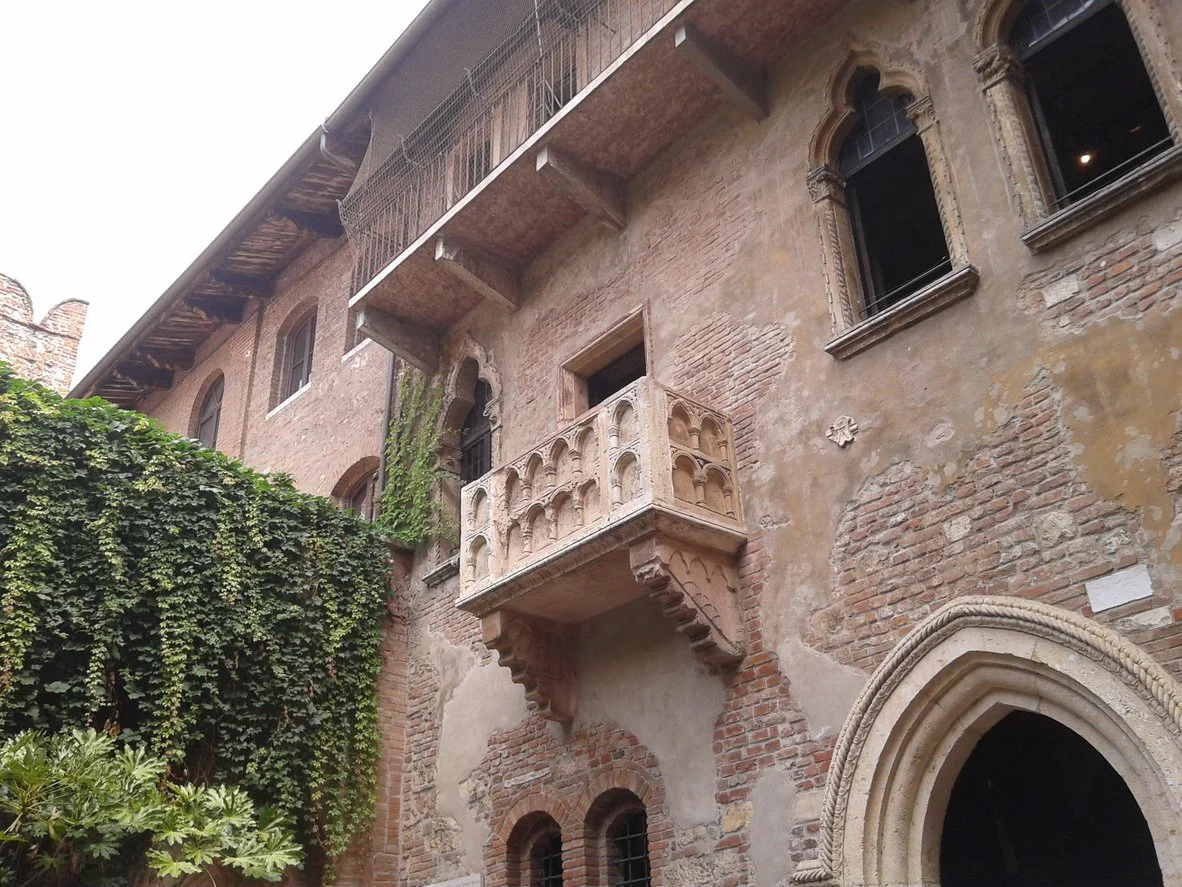
Juliette’s balcony
Verona Italy
shemot
names
A new king, who did not know Joseph, arose over Egypt.
And so begins the tale of our enslavement and redemption. Everything we’ve read so far in the Torah, all of Beresheet, has been our backstory. It’s all been leading up to this moment, to this series of events that ultimately will define who we are. But before we dive in, let’s consider the title of our parasha, the title of the book we’re about to read.
The name of the first book of Torah is Beresheet, or Genesis according to the gentile world. The meaning of the two words is essentially the same—while we have a slightly different take on the meaning of beginning, we’re all in agreement that what we’re talking about is a beginning.
Not so the second book that we begin this week. Exodus, in Greek, means going out. With most books, the title tells you what it’s about, and this title, Exodus, tells us that the most significant theme of the book is God’s taking the children of Israel out from Egypt and out from slavery. That makes perfect sense because—clearly—that’s what the story is about.
But Jews know the second book as Shemot, Names. On the surface the reason seems to be simplistic. Each book of Torah is called by the first word in the book, and every parasha is known by its first word. (Not counting, of course, words like, “God said to Moshe,'“ or just about every parasha would have the same name!) So, while by chance the word Beresheet happens to tell us what that book is about, it seems that Shemot does not.
That got me thinking. Nothing in Torah is random. Is it possible that, even though we’re reading a story about leaving Egypt, maybe there’s another meaning, a hidden meaning? Could the concept of “Names” also be an important theme of this book?
——————————————————————————
Think back to 9th grade English class. A distraught Lady Juliette cries… “Wherefore art thou Romeo?”
Or in modern English, “why do you have to be Romeo? Why can’t you deny your name and take on some other name? All our problems would be solved!”
Shakespeare seems to be telling us that names shouldn’t matter, that in and of themselves they have little meaning. But, if Romeo Montague were instead called Shlomo Finklestein, do you think that he’d still be that same dashing, irresistible young nobleman with whom the teenage Juliette was so besotted?
Or would that name make him into some other person?
He’s Romeo because that’s what makes this Juliette’s story. If he were not Romeo, there’d be no story here, no epic tale. Yes, a rose by any other name would still smell as sweet. If a rose smelled like maple syrup it would still smell sweet. But, would it be a rose?
I think HaShem disagrees with old Willie. It seems obvious that HaShem thinks names are very important. After all, one of the first things HaShem has Adam do is to give a name to each creature, according to its nature.
Let's take a quick peek ahead into next week's parasha, Va’eira. The parasha begins with God saying to Moshe, “I am Adonai.” Why would it begin with God introducing God’s self to Moshe? Did HaShem forget that they’ve already met? They’re already pretty deep into the project here!
Back in Parasha Vayigash a few weeks ago, we came upon a similar situation. We considered why HaShem would feel the need to introduce Godself to Jacob who should already know who God is.
And here, once again, that question arises. Why does Va’era, “I appeared,” begin with HaShem introducing God’s self to Moshe?
What’s happening is that HaShem is telling Moshe that, from now on, HaShem is going to relate to Moshe through a different name. HaShem says, your forbearers knew me as Romeo, but I’m sharing a secret with you that I’ve kept hidden until now. I am Shlomo Finklestein!
I think HaShem is saying to Moshe, “In our first conversation, I told you that my name is ‘I will be as I will be.’ That’s the name I gave you to share with the children of Israel.
So, I suppose you’re now wondering, Wherefore art thou Adonai?”
For your forbearers I was EI Shaddai because that's who they needed me to be in order to hear their summons, for their growth, for their call to action, for their epic story. As El Shaddai I told Abraham, ‘Lech Lechah’— go take a walk for yourself. For you, I am Adonai because that is who you need me to be for you now, in order for you to become who you must be, for you to become who I need you to be.”
Adam looked at the funny animal with the long curved neck and the hump and declared, “Camel!” A camel is a camel is a camel. It’s going to look like a camel, think like a camel, and act like a camel, every time. It’s a camel.
Human beings are more complex than camels. Each of us has an innate sense of who we are, as we look into the mirror of our own eyes. But others have their own lens through which they see us. I think, now that I've attained a certain age, that I know who Debra is. But I have many titles, and I imagine that each one has its own definition of "Debra." I’m mother, I’m daughter, I’m grandma, I'm sister, I’m wife, I’m friend, I’m colleague, I’m congregation member...the list goes on. Perhaps, the truth of who each of us is, is a prism made up of all these different perspectives. In order to get to that ultimate truth, one would have to be able to see all these angles concurrently.
Sometimes we need the keen perspective of another to help us see what we need to do, who we need to be. And in moments when we aren’t seeing the whole picture clearly, sometimes we need someone to intervene on our behalf.
Because Moshe's wife was a Midianite and their son was born in Midian, Moshe hadn't bothered to circumcise the boy. But, in no way could Moshe return to Egypt and approach b'nai Yisrael as an Israelite, as one of them, without earning that name of "a father in Israel." And so, HaShem set forth to kill Moshe during the family's journey back to his home. Zipporah understood this, and quickly circumcised the child herself, grabbing a nearby rock to do the deed. In that moment, Zipporah was transformed; she became a "mother in Israel."
If a name is going to belong to us, that name has to be earned.
According to the mystics, HaShem has 72 names by which HaShem appears. Maybe one of the things that Shemot is telling us is that HaShem meets us where we are. HaShem is forever revealing Gods’ self to each of us, appearing by the name that we need HaShem to be in that moment so we can hear the summons, hear our call to action. We look into the totality of HaShem and the particular refraction we see at any time is the one that will lead us to grow and go forward in our own epic tale. Sometimes that can be intellectually stimulating, sometimes spiritually enlightening, sometimes emotionally comforting, and sometimes it’s less than comfortable, but it’s always geared toward furthering our soul’s journey.
It’s up to us to notice that the shrubbery is on fire.
So what shall we eat?
A rose by any other name would still smell as sweet. Juliette might have had Pollastro Arrosto in mind when she made that famous statement. In this 14th century Italian dish, chicken is roasted with orange juice, cinnamon, and rosewater. Since sweet oranges had not yet made it to Italy, we must assume that sour oranges were what the recipe called for. In my adaptation, I’m using bitter orange marmalade. A feast that featured this dish might also include blanched and sautéed fennel, mushrooms sautéed with onion, and a pasta.
The lasagne of the 14th century is very different from the cheesy baked dish we know today. Squares of pasta sheets were layered with spices—and sometimes with grated hard cheese—dressed with a sauce of almond milk, sweetened with sugar and infused with saffron. One would eat this creation by picking up a stack of these squares with a sharp stick. While that sounds like fun, (my grandkids would love it!) I'm going to go with modern conventional silverware. For our version of the dish, we're going to boil sheets of fresh lasagne, cut them into squares, and dip them into a lightly sweetened bechamel made with walnut oil, almond milk, and saffron. We'll stack them and finish the dish with more of the sauce poured over.
But where are the greens? You know I can't do dinner without greens! There’s some question over whether or not greens would have been included, as they were thought by some to be peasant food, and the nobility would be horrified to eat peasant food. Peasants or otherwise, we will include them. We'll start our meal with a hearty soup made with mixed greens and white beans in a garlicky stock. It's delicious and nutritious and comes together in minutes if you’ve got stock on hand. For the vegetarians who will forego the chicken, the beans will also supply the necessary protein for a balanced meal. With all the other dishes being served, I promise that no one will go away hungry if you skip the chicken.
The desserts we enjoy today are very different from the sweets one might find in medieval Europe. Sugar and spices were very expensive and were only available to the wealthy. Fruits were highly suspect and many doctors advised against them. If they were to be eaten at all, it was best to cook them. These pears poached in red wine would have been a lovely finale to an upper class dinner.
This might well have been the meal—or at least part of the meal—served at the Capulet dinner table that evening, before our young heroine retired to her balcony.
Menu For Parasha Shemot
a journey to 14th century italy
GOlden shabbat challah
minestra
greens and white beans in broth
Pollastro Arrosto
chicken roasted with orange, cinnamon, and rosewater
lasagna alla Capulet
with a béchamel of saffron and almond milk, poudre forte
finocchio—caramelized fennel
mushrooms sautéed with onion
pears poached in red wine with warm spices
But wait, there’s more
A new post for a new year! The following story is an excerpt from my upcoming book,
The Spiral Journey of the Cosmic Artichoke—a Passover Haggadah
A How-To and Why-Bother for Assimilated Jews of the Twenty-First Century…and anyone one else who’s interested.
Shemot, the Book of Exodus, picks up where we left off at the close of Beresheet. Jacob has given his blessings to the tribes, has passed on the covenant of Abraham that he received from his father Isaac, and has died. Generations have passed.
A new king, who did not know Joseph, arose over Egypt. He said to his people, “Look: the people, the Israelites, are becoming more numerous and stronger than us. Let us deal cleverly with them lest they increase and, in the event of war, join our enemies, fight us, and go up out of the land.” They appointed draft officers over them in order to afflict them with chores. The Israelites built up the cities of Pitom and Ra’amses, making them storage cities for Pharaoh. But the more the Egyptians afflicted them, the more they increased and spread, and the Egyptians were disgusted over the Israelites. The Egyptians enslaved the Israelites with backbreaking labor. They embittered their lives with hard labor—making them work with mortar and bricks—as well as with all kinds of work in the field. All the work they subjected them to was imposed with crushing harshness.
A Possible Reality based on Torah, Midrash, and the musings and meanderings of my mind….
Long, long ago, about 3400 years ago, there lived in Egypt a woman, Yocheved, and her husband, Amram, Israelites of the tribe of Levi. They had two children, Miriam and Aharon. The family’s life was fraught with difficulty. Back when their people had first come to dwell in that land they were welcomed and honored, having been the family of the Pharaoh’s revered governor. But, politics being what they are, there was now a new regime in power and things had changed.
Now, there was a new Pharaoh who ruled over Egypt. He observed the Israelites and, not knowing the history of how they came to be living there, saw only a group of immigrants who had grown numerous. He feared them as a potential threat and so he enslaved the Hebrews to prevent them from amassing power and waging war against him. Naturally, the source of free labor was handy. He also figured that by making their lives miserable, by seeing to it that they’d be exhausted by the end of the day and not in an amorous mood, it would result in their diminished numbers, thereby reducing their threat. Cleary a win-win for him.
Things didn’t go according to his expectations, however. The women fashioned mirrors out of copper, to beautify themselves. They then met their husbands in the fields, brought them lunch, and teased them with the mirrors and erotic gameplay. Their numbers continued to mount and Pharaoh’s fears about the Hebrews encouraged him to take horrific measures.
Pharaoh ordered the midwives to kill all Jewish baby boys as they were born, and to allow only the baby girls to live. The plot was unsuccessful. The midwives ignored the directive and informed Pharaoh that the Israelite women were much more energetic than Egyptian women, and so the babies were born before the midwives arrived.
His next step was to send out a decree demanding that every baby boy born to the Hebrews was to be instantly drowned in the Nile.
Amram, a community leader and activist who believed that it would be better for these babies to never be born, divorced his wife and encouraged the other men of the community to do the same. One day, five-year-old Miriam approached her father and asked to speak to him. She pointed out that, while Pharaoh’s decree was killing baby boys, Amram’s decree was killing the Hebrew people, for it also prevented the birth of baby girls.
Out of the mouths of babes, eh? Amram saw the error of his ways and he and Yocheved were remarried.
The wedding was purposefully very public, for Amram wanted to encourage those who followed him into divorce to follow him into remarriage. Miriam and Aharon danced joyously at their parents’ wedding as the music loudly played. The entire community was there to celebrate; however, these invited guests were not the only ones present. Watching closely at the sidelines were government officials who knew that this remarriage, and the others that would be sure to follow, would result in Israelite births.
It was six months later that a baby was born to Yocheved and Amram, a son three months premature. The child was called Chaver by his father and Avigdor by his grandfather, but the name that stuck for this baby boy was the one given to him jointly by Yocheved and the Egyptian Princess who became his adoptive mother.
How did this strange adoption come to be? Stick around and I’ll tell you.
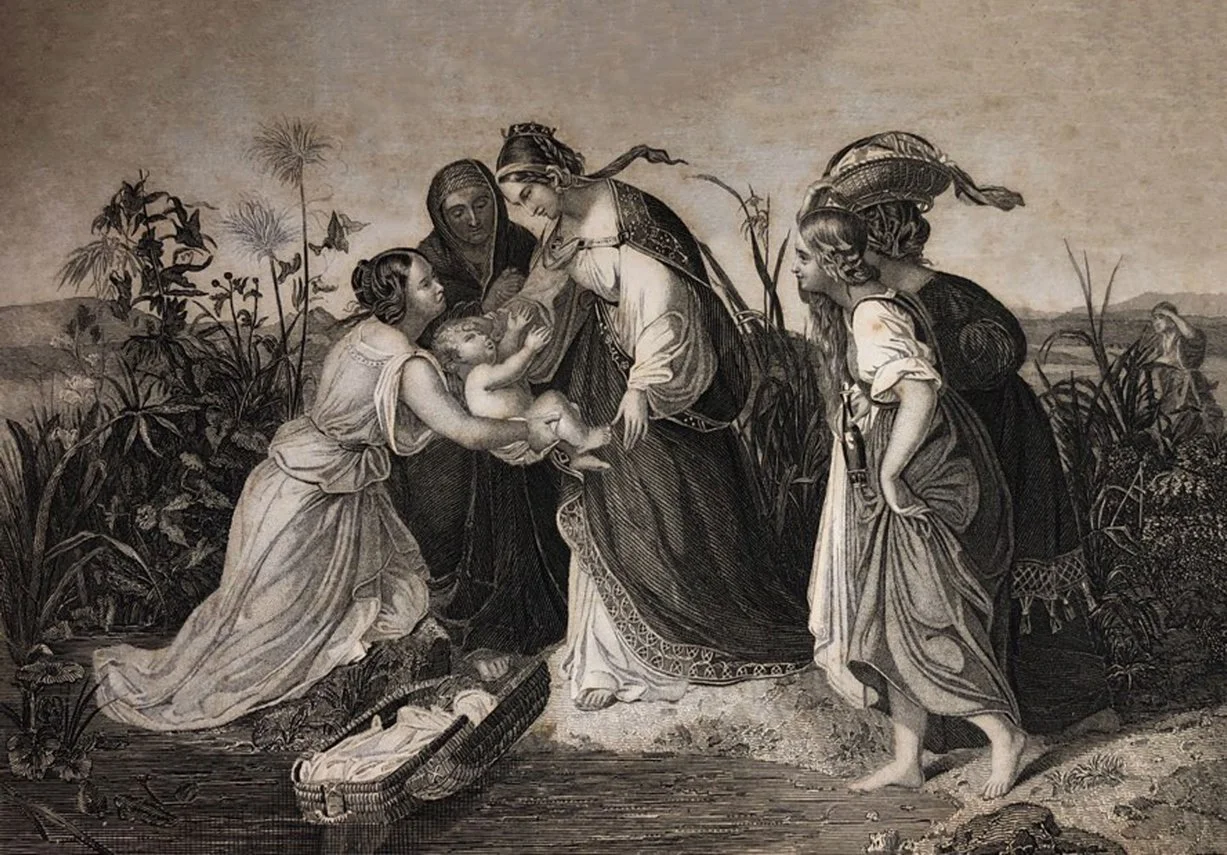
It was easy to hide the baby for three months—as a preemie, his cries were weak and couldn’t be heard from outside the house. Also, due to his birth being premature, the government officials were not yet anticipating a birth. But after three months, his cries grew stronger and the officials began to snoop. Yocheved knew that she had to act—the baby’s survival was at great risk. She wove a basket of reeds, placed the baby inside, and set it among the tall grasses growing at the edge of the river. She sent her daughter Miriam to attend the basket, not so closely that she would draw attention to herself, yet closely enough to watch for what her tiny son’s fate would be.
In time, the Princess came to the river to bathe. She discovered the baby and realized who he must be, an abandoned child of the Hebrews. She was determined to take him home and raise him as her own. She also knew that she had to find a woman who could nurse him. Bravely, little Miriam stepped forth and approached the Princess. She led the Princess to her own home and to the child’s own mother.
One has to wonder, why did the princess look to the Hebrews for a wet nurse? Surely she could have found an Egyptian woman to nurse the child!
A few days before, she’d gone down to the Nile to bathe, as was her daily custom. There, floating on the river, was a bloated, dead infant. From a short distance away, she could hear the wailing and lamenting of women. She was horrified, and she wept over the tiny corpse.
This was the pivotal moment of her life.
The event started a cavalcade of emotions and thoughts that culminated in her rejection of, first her father and his cruel decrees, and then a total rejection of his religion and his gods.
On this particular day, she’d gone to the river to perform a personal mikveh, to rid herself of the sin of idolatry. And this time, the child she discovered was alive!
What an extraordinary miracle that, on the day of her conversion, God should place the greatest prophet the Israelites would ever know, into her hands!
And Miriam led Batya to her family’s home.
In my mind I can see the meeting of these two women. A young Princess, daughter of Pharaoh, brimming with the maternal instinct that floods the body and soul of a hormonal teenage girl, is standing at the doorway of a hut in the Jewish district, holding an infant in her arms. She beholds the woman of the home, regards her simple but well-kept abode, sees a mother’s love in her eyes.
They are as different as two women can be, but each recognizes the kindness in the other and there is mutual respect. The Princess understands immediately that this is the baby’s mother. She understands what the mother was trying to accomplish by placing him in the river.
I can almost hear their conversation. The young woman cooing over the tiny child is already besotted with him and is determined to protect him, to have him for her own. She is quite accustomed to getting what she wants. Yocheved easily convinces her that it will be best for the health of the child if he remains with his natural mother to be nursed until he’s four years old. She knows that this is enough time to instill Jewish values in him and to teach him who he is. And the fee she will receive from the princess for caring for the baby is no small deal for a family of slaves.
Of course, as his legal mother, the Princess may visit him at her leisure. The result of her frequent visits is that, on the day that she will come to claim him, the child will know her and feel comfortable going with her.
Together they decide upon a name. He will be Moshe, which means drawn from the water. Yocheved knows that this name is proper because it commemorates the event that will be pivotal in determining his future.
shabbat shalom!