
roast cornish game hens in a Pilaf “nest”
or other game birds, such as quail, squab, partridge, or grouse
with savory Red wine and raspberry sauce
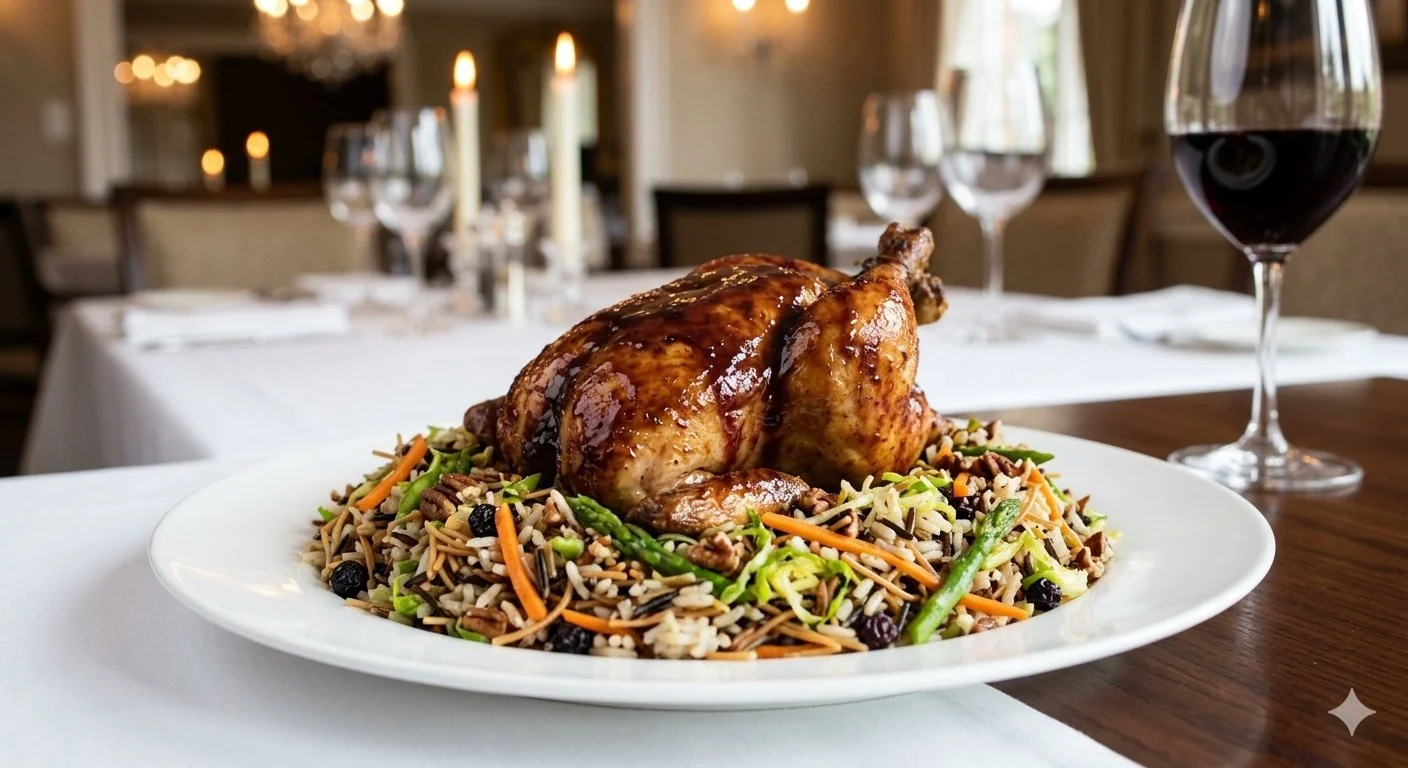
roast Cornish game hens in a nest
with savory Red Wine Raspberry Sauce
or other game birds, such as quail, squab, partridge, or grouse
I think you’ll agree that this is a great recipe. What makes it great?
The result far surpasses the time and effort it takes to make it. It looks impressive and tastes fabulous, creating the perception that you’ve spent hours in the kitchen. Truth be told, if you’ve got 15 minutes to prepare the birds and an hour to let them roast, you can easily whip this up.
(If you’re using birds that are smaller than Game Hens, it will cook even faster).
Use the roasting time to prepare the sauce and the pilaf “nests,” or for any sides you’re going to serve.
Note: If you’re making the nests, you’ll probably need a little extra time, with all the cutting and steaming and whatnot. That can be mitigated by making some components of the pilaf ahead of time.
Game birds have a deeper flavor—are more succulent and juicy—than domestic chickens from the market. They also give the message that says to diners, this is a fancy meal. But . . . you could even use this recipe for a roast chicken, especially for a quick but lovely weeknight meal.
The sauce, with a hint of raspberry sweetness, comes together quickly and turns a simple roasted bird into something that’s worthy of your most important occasions, but it’s quick and easy enough to make anytime you want to turn out an especially nice dinner.
The two hens will serve 2 to 4 people. Serve each person one whole, or one half hen, depending upon the size of the hen and the appetite of the diner, and the other dishes/courses you’re serving.
Raspberries—Frozen or Fresh?
While a bowl of fresh raspberries for snacking takes me to my happy place, for raspberry sauces I usually turn to frozen berries. Freezing them encourages the berries to quickly shed their juice when heated, and the results are more predictable than with fresh. It’s easy to keep a bag on hand, to reach for whenever the mood strikes. Most of my raspberry sauces start with frozen berries, with the addition of some sugar to offset the tartness of the fruit. With those two ingredients as a springboard, I have before me a canvas that, with the addition of various spices, herbs, and liquids, can become an almost infinite number of sauces to grace either savory foods or desserts.
But…for these birds I wanted something different.
My goal was to create a sauce that was also a glaze to give the hens a beautiful, glossy, mahogany, sticky finish for the crispy skin.
I decided to forgo the berries themselves in the sauce this time. Instead, I added some raspberry jam to a simple red wine sauce that could be put together quickly. I’m happy to say that the results were delicious. The sauce has just a touch of sweetness from the jam, but the over-all flavor is more savory that sweet, and the whole is beautifully balanced with the final addition of raspberry balsamic vinegar. A few fresh raspberries for garnishing the birds are all the berries you might want here.
Of course, like with any dish, the quality of the result is dependent upon the quality of the ingredients. Lately it seems that every time I go to the grocery store the prices for everything are higher than they were the week before. I admit I was tempted to save some money by buying a less expensive jam. But, when I read the ingredients in the national brands, I just couldn’t bring myself to put any of them in my cart. I eschew all products that contain ingredients created in a lab.
The question of whether high fructose corn syrup, artificial flavors, colors, sweeteners, and preservatives are bad for your health has long been settled, but there’s another truth in play—they also don’t taste very good (at least, not to me).
I highly recommend you choose a raspberry jam (or any jam you want for any occasion) with only fruit, sugar, and possibly pectin. There are plenty of good brands available. Yes, they’re a bit more expensive, but it’s money well spent. Personally, I’ve always been a fan of Tiptree preserves and I was excited to discover that, on Amazon, they’re cheaper than they are at my local supermarket. And Tiptree seems to be cheaper at Amazon than the other high-end brands they sell. You can find it here.
Balsamic vinegars vary greatly. The best ones are absolutely sublime, and very costly. There are less expensive ones that are still very nice, and then there are very inexpensive ones that are awful. Generally speaking, I’ll go for the best one I can afford. But, how you’re going to use it is also a factor. The truly authentic balsamic vinegars are gorgeous when used as a finishing touch—a drizzle over a dish or a dessert—but their magnificence is lost when combined with other ingredients in a sauce. So, for this purpose I’ll go for one that’s mid-range and save the really good stuff for when its glory can be fully appreciated. I like using raspberry balsamic for this dish, but any decent balsamic will do. For fruit-infused balsamic vinegars, these from OMG are my go-to.
The elegance of the dish is accentuated by the sides and the way it’s plated. For a weeknight roast chicken dinner, you can eschew the nests and instead, toss some seasoned vegetables into the oven for the last fifteen minutes of roasting and have a complete dinner. You can also add some cut-up potatoes to the pan with the chicken, for an even more complete dinner.
When I prepared these hens for a fancy-shmancy dinner I took the plating to the next level.
I served these birds on a nest . . . because birds should be in nests when they’re not flying or walking about.
These nests also made it unnecessary to add any other sides to the plate, as they consist of vegetables and mixed grains. If you serve a light salad before the main course (or after, for a European touch), there will be no question about whether the meal has enough vegetables included.
Note: I always reach for organic produce when it’s reasonable to do so, but I’m pretty much adamant about it when I’m using the peel of any citrus fruit.
Cornish game hens in a nest
with savory Red Wine Raspberry Sauce
Serves four
Note: I’ve used walnut oil here, to complement the flavor of the walnuts in the pilaf. You can use any good, flavorful oil, including a good fruity olive oil.
For the Birds
Ingredients:
2 Cornish game hens, 4 squab, 8 quail, or 1 medium roasting chicken
a splash of walnut oil
1 teaspoon finely chopped fresh rosemary leaves
a dash of each of the following: kosher salt, freshly ground pepper, garlic powder, cardamom, an paprika.
Method:
Preheat the oven to 350°
Massage the birds with just enough olive oil to coat them. Sprinkle the cavities with salt, pepper, garlic powder, cardamom, and the rosemary leaves. Use a light hand. Bear in mind that if you’re using kosher poultry, it has already been salted, so it will need little, if any, additional salt.
Set the birds on a parchment-lined pan and sprinkle the tops with paprika.
Slide the pan into the preheated oven. While the hens roast, make the sauce.
For the Sauce
The recipe yields a generous amount of sauce; enough for 2 Cornish game hens, 4 squab, 8 quail, or 1 medium sized roasting chicken
Ingredients:
2 tablespoons walnut olive oil
1 small onion, diced small
2 cloves garlic, minced or pressed
1/4 teaspoon ground cardamom
a pinch each of salt and pepper
2 tablespoons flour
1/4 cup dry red wine
1 cup chicken stock
1 sprig fresh rosemary
2 tablespoons raspberry balsamic vinegar
¼ cup raspberry jam
1 tablespoon finely grated organic orange peel
Optional: 1-2 teaspoons sugar
Method:
Warm the oil in a small saucepan. Add the onion with a pinch of salt and sauté over low—medium heat until it’s just beginning to turn color.
Add the garlic, the cardamom, and a twist or two of the pepper mill, and sauté for another 30 seconds or so.
Then add the flour and whisk for a few minutes, to cook the flour.
Add the wine and whisk until it’s mostly cooked out. This won’t take long.
Add all the remaining ingredients, whisking until everything is well combined.
Simmer over the lowest heat that will keep it at a very gentle simmer, stirring often, until the sauce is thickened. This will take a little while. If you rush it, all the flavors won’t develop properly.
Taste the sauce for salt. Depending upon the stock you’re using, it may or may not need more. If you think the sauce can use a bit of sweetness, add the optional sugar.
Remove the rosemary sprig and your sauce is ready to use.
If you’d like a smoother sauce, purée it with an immersion blender, or in a food processor.
Finishing the Hens
Roast the birds for about 45 minutes. Check them for doneness. Smaller birds will be ready, larger ones may need an hour.
Optional: This extra step will give you crisp skin on the bottom of the birds, as well as on the top. Turn the birds breast side down. Switch the oven to the broil setting and put the pan under the broiler to crisp the skin (This can take as little as 30 seconds, so watch carefully—it can go from crisp to burned very quickly.) Then, using a basting brush, brush them lightly with the sauce and slide them back under the broiler for a few more seconds to set the glaze. Then, turn them breast-side up again. Drop the oven temperature back to 350° to finish roasting.
Brush the tops of the birds with the sauce and let them roast a bit longer, until they look nicely glazed.
Check that the internal temperature of the breast meat has reached 165°. If it has, remove the hens from the oven. If not, continue to roast them a little longer until they come to temperature.
To Make the (Pilaf) Nests
With the goal of creating the illusion of a nest in mind, the contrast of textures and flavors in this pilaf make it an absolute winner, here or for any time.
The roasted julienne vegetables are the twigs, the wild rice and vermicelli provide a nice chew, the nuts add a bit of crunch, the currants and orange peel add a touch of sweetness to balance the savory, and the soft white rice provides structure.
In addition to these nests, you can use the pilaf as a delicious side dish with any meal.
Ingredients:
walnut oil as needed, for roasting and sautéing
¼ cup finely chopped onion
1 to 2 cloves garlic, minced
2 medium carrots, cut julienne
6 asparagus stalks (look for thicker ones), cut in half lengthwise, then in half again, and then into 1 inch pieces horizontally (first trim the woody ends)
⅓ cup trimmed and shredded Brussels sprouts
½ cup wild rice
½ cup vermicelli
½ cup white rice (I go with a short grain rice, but any will do)
1 teaspoon herbs de Provence
1 ½ cups chicken stock
2 tablespoons currants
2 teaspoons grated organic orange peel (I use a microplane)
¼ cup pecan or walnut pieces, lightly toasted
kosher salt, as needed
a few grinds of black pepper
Method:
Preheat the oven to 350°.
Prepare the wild rice according to package instructions and set it aside. You can make this a day in advance, if you like.
Combine the julienne carrots and asparagus with the shredded sprouts on a sheet pan (line with parchment for an easy clean-up). Toss it with just enough oil to have everything dressed, but not drowning. Add a sprinkle of salt and a dash of garlic powder, toss, and spread the vegetables out into one layer on the baking sheet. Roast the vegetables for about 10 minutes, or until they’re tender and just beginning to pick up color. Set the roasted vegetables aside. You can also trim the vegetables a day in advance if you store them in the fridge in a bowl of ice water.
Pour a splash of oil into a medium saucepan and sauté the onion until soft and translucent.
Add the garlic and the vermicelli to the pot and stir (gently, so as not to break the vermicelli) until the vermicelli and the onions are golden.
Add the white rice and sauté for another minute or so, to coat the rice with the oil (you may need to add a bit more oil)
Stir in the herbs de Provence
Pour in the stock, add in the currants and the orange peel, and bring it to a boil. Cover the pot, turn the heat down to very low, and cook for 18 minutes.
Remove the pot from the heat and let it rest with the cover on for about five minutes or so. Then remove the cover, fluff the pilaf with a fork, and add in the cooked wild rice, the roasted vegetables, and the nuts. Stir very gently (using a wooden spoon or silicone spoonula) to combine, then replace the cover and keep it warm until ready to serve.
To serve the Cornish Game Hens in a Nest
Spoon a circle of the pilaf in the center of the plate to create the nest. It should be flatter in the center, where you’ll set your bird, than it is on the edges that surround it—nest-like. Drizzle it all with the Red Wine Raspberry Sauce and serve the dish with more sauce on the side.
Did you make it? Was it fabulous?